
A reverse osmosis system should be selected from your water conditions, household demand and independently supported performance claims. Product names often emphasise gallons per day, filtration stages or smart displays, but those numbers answer different questions. This guide focuses on practical comparison points for Waterdrop and similar under-sink systems.
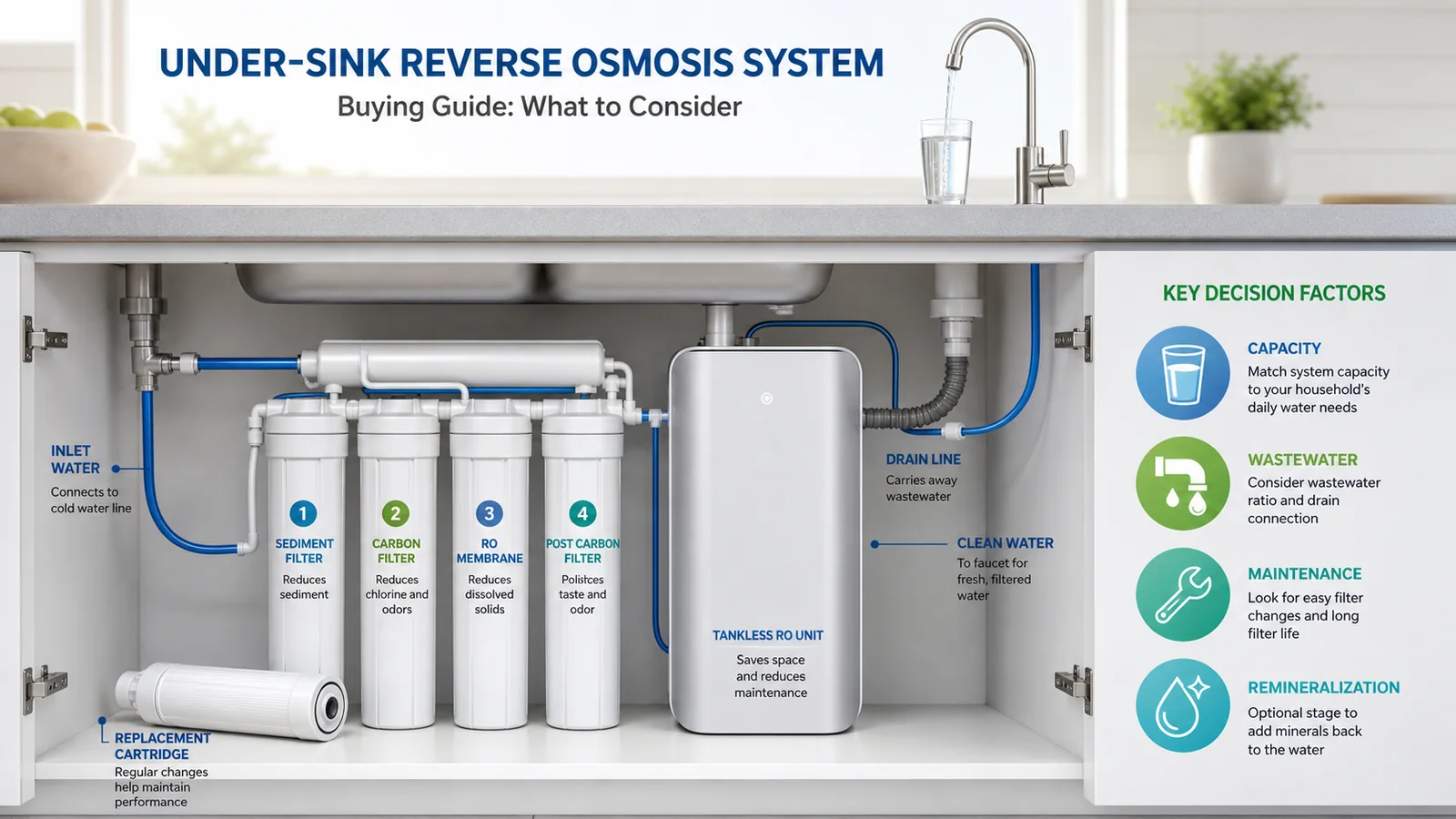
Begin with your water source
Municipal water and private well water can present different issues. Obtain a current water-quality report or appropriate test before choosing equipment. Reverse osmosis can reduce many dissolved substances, but no single system is the correct solution for every contaminant or microbiological risk. If your water may be unsafe, seek advice from a qualified water-treatment professional.
Look for specific performance evidence
Do not rely only on the number of “stages.” Check which contaminants the manufacturer claims to reduce and what certification or test standard supports those claims. Certification applies to the exact model and stated function, not automatically to every product from a brand. Verify the certification listing and operating conditions where the decision is health-sensitive.
What GPD capacity means
Gallons per day describes rated production under defined conditions. Actual output varies with feed-water pressure, temperature and dissolved solids. A higher GPD rating can improve flow and recovery time for a busy household, but it does not by itself prove better contaminant reduction. Consider peak use: drinking, cooking, coffee machines and filling containers may occur close together.
Tankless versus tank systems
Tankless systems can save under-sink space and deliver filtered water on demand, but they require power and adequate feed pressure. Traditional tank systems store treated water and may suit locations where electrical access is inconvenient. Measure the cabinet, account for plumbing and drainage, and ensure filters remain accessible for replacement.
Wastewater ratio
RO filtration sends a portion of water to drain. Manufacturers may publish a pure-to-drain or drain ratio, but compare figures carefully because terminology and test conditions differ. Water pressure, temperature, membrane age and feed quality can affect real performance. A strong ratio is useful, but it should be considered alongside verified filtration and system reliability.
Remineralization and taste
Reverse osmosis reduces dissolved minerals along with unwanted substances. Some systems add a remineralization stage to alter taste or pH. This is a preference and product-design question, not proof that one system is universally healthier. Check what media is used, when it requires replacement and whether the claim is supported for the exact cartridge.
Filter life and ownership cost
Calculate the cost and replacement schedule of every cartridge, membrane and remineralization filter. “Up to” filter-life claims depend on usage and water quality. Confirm availability, model numbers and whether the system provides a reliable replacement indicator. Include installation, leak protection and possible professional service in the budget.
Installation questions
- Is an electrical outlet required?
- Will drilling be needed for the faucet or drain connection?
- Does feed-water pressure meet the stated range?
- Is there space to replace filters without removing the system?
- Are the supplied fittings suitable for local plumbing?
- What leak-detection or automatic shutoff protection is included?
How to shortlist a system
- Identify water concerns using a report or test.
- Verify model-specific filtration evidence.
- Estimate peak daily and momentary demand.
- Measure cabinet and check power/plumbing requirements.
- Compare wastewater performance under stated conditions.
- Calculate three years of replacement-filter costs.
- Review warranty and local support.
Review current Waterdrop offers and explore home and living deals. A temporary coupon should influence final price only after the system itself meets your water and installation requirements.
Reverse-osmosis shortlist table
| Decision | Useful evidence | What it does not prove |
|---|---|---|
| Contaminant reduction | Exact model certification or model-specific test documentation | A large number of filtration stages alone |
| Flow and capacity | Rated GPD plus stated test conditions | Identical output in every home |
| Water efficiency | Clearly defined product-to-drain ratio | Performance independent of pressure, temperature or filter age |
| Ownership cost | Replacement cartridge schedule and current cartridge availability | The lowest initial purchase price |
| Installation fit | Cabinet measurements, pressure range, power and drain requirements | The word “tankless” by itself |
Who should buy an under-sink RO system—and who should not?
An RO system is worth considering when a water report or suitable test identifies concerns the exact model is documented to reduce and the household can support its installation and maintenance. Do not choose one from marketing claims alone when water may contain microbiological hazards, the feed conditions fall outside specification, or replacement filters will not be maintained. In those cases, consult a qualified local water-treatment professional.
How this guide was researched
We reviewed official Waterdrop UK reverse-osmosis product and support information and separated capacity, efficiency, certification and maintenance into distinct decisions. Because this is a health-adjacent topic, the guide avoids claiming that one system makes every water supply safe. Sources were checked on 14 August 2026; no independent laboratory water test was conducted by CouponzWorld.
Official and independent verification sources
Research basis: official Waterdrop system, capacity, filter and installation materials plus standard RO purchasing considerations reviewed in August 2026. This guide is general shopping information, not water-safety or medical advice.